
Therapeutic approaches
Personnels involved: Séverine Bégard, David Blum, Luc Buée, Valérie Buée-Scherrer, Charlotte Branquart, Thierry Burnouf, Raphaëlle Caillierez, Léna Chesnais, Clément Danis, Vincent Deramecourt, Sabiha Eddarkaoui, Emilie Faivre, Giovanni Ferro, Coraille Formentin, Nicolas Geoffre, Marine Hervet, Dimitri Kwiatkowski, Brenda Lammens, Nhi Le, Sarah Leclercq, Thibaud Lebouvier, Simon Lecerf, Evangelia Manousaki, Abinaya Srinivasan, Simon Thiou
We are developing several thematic areas aimed at developing new therapeutic modalities and providing proof of concept in cellular and animal models in order to enable the development of therapeutic trials in patients with Alzheimer's disease and Tauopathies.
In collaboration with Isabelle Landrieu (CNRS, Lille), we selected, characterized, and optimized various sets of single-domain antibodies from Camelidae, also known as nanobodies or VHHs, that target different epitopes and forms of the Tau protein. These nanobodies are ten times smaller than conventional antibodies and can access cellular areas inaccessible to classical antibodies. They represent a promising alternative to conventional monoclonal antibodies, with increased potential for intracellular targeting and improved tissue penetration. Their development could lead to more effective and less invasive treatments for neurodegenerative diseases. They are capable of specifically recognizing different forms of Tau, both outside and inside cells. (https://lejournal.cnrs.fr/maladie-alzheimer-demence-neurones-nanocorps).
This paves the way for innovative therapeutic strategies for neurodegenerative diseases such as Alzheimer's, where the accumulation and propagation of Tau are implicated in neuronal death. We use these molecular tools to study the various pathophysiological mechanisms of Tau, such as liquid-liquid phase separation (condensation), aggregation, and propagation. We are also evaluating the therapeutic potential of nanobodies in different models that reproduce Tau pathology.
In this context, we have recently developed nanobodies capable of blocking the internalization of the Tau protein by neurons (https://www.insb.cnrs.fr/fr/cnrsinfo/comprendre-alzheimer-des-petits-anticorps-prometteurs). We are also developing nanobody conjugates capable of targeting Tau in living cells, including neurons, to modulate its binding to its partners and interfere with its pathological role. This work could revolutionize the management of tauopathies in the coming years. To this end, we are training a generation of future researchers within our European doctoral network TAME (https://tame-itn.eu/).
![[Translate to English:] TAU VHH](/fileadmin/_processed_/1/1/csm_TAU_VHH_741e3249af.png)
From a pharmacological perspective, we are interested in the therapeutic properties of caffeine and the targeting of its brain receptors.
Caffeine is the most widely consumed psychoactive substance in the world. Various epidemiological studies, Our own studies, including those conducted on humans, indicate that regular/chronic caffeine consumption reduces cognitive decline during aging and also the risk of developing Alzheimer's disease. Our animal studies have, for the first time, provided a molecular basis for the cognitive effects of caffeine, promoting epigenomic plasticity in neuronal and non-neuronal cells of the hippocampus.
All of this work has fostered a major translational development, the CAFCA project (NCT04570085; https://www.cafca-alzheimer.fr/), A phase 3, randomized, double-blind, placebo-controlled clinical trial led by Professor Thibaud Lebouvier (CMRR Lille and member of the laboratory). We also aim to better understand the molecular effects of caffeine within different cell populations by combining epigenomic and electrophysiological approaches in animals with studies of plasma epigenetic biomarkers in patients from our CAFCA trial.
Caffeine is a non-selective antagonist of A2A adenosine receptors, whose A2AR levels are abnormally elevated in neurons and astrocytics during brain aging, and even more so in Alzheimer's disease and other primary tauopathies. In this context, we are investigating the pathophysiological consequences of neuroglial dysregulation of the A2A receptor at the neuropathological and molecular levels. We are also evaluating its role in the prion-like propagation mechanisms of tauopathy with the aim of developing an anti-A2A therapeutic trial in the context of primary tauopathies (Collaborations: Anne-Laurence Boutillier, LNCA, Strasbourg; Christa Müller, Bonn; Annett Halle, DZNE, Bonn; Etienne Audinat, IGF, Montpellier; Yijuang Chern, IBMS, Taipei, Taiwan; Sabine Levi, ESPCI, Paris).
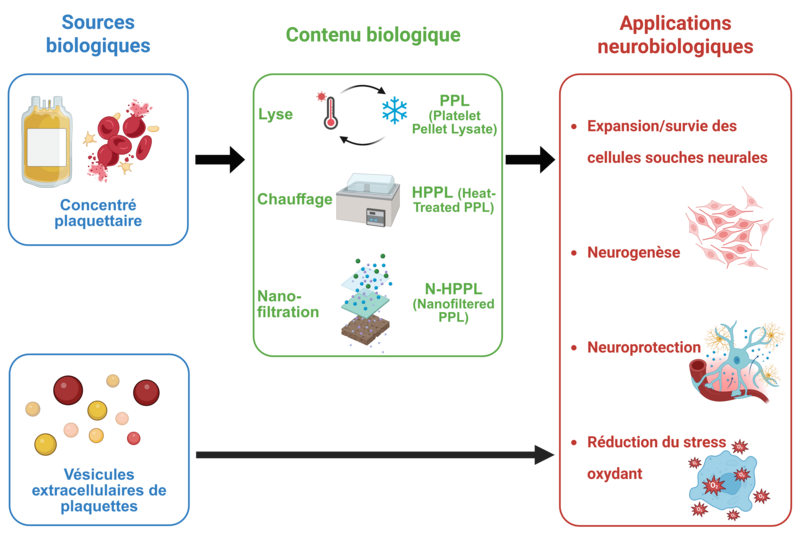
Finally, in collaboration with Gregory Kuchcinski, David Devos, Anne-Sophie Rolland(Team TREAT), and the laboratory of Professor Thierry Burnouf at Taipei Medical University (Taipei, Taiwan), we have been developing a project on the platelet secretome for several years. The latter contains a synergistic cocktail of trophic factors, including growth factors, cytokines, anti-inflammatory and antioxidant molecules, which have the potential to promote neuroregeneration and neuroprotection.
Our goal is to study the preclinical therapeutic potential of these platelet preparations in murine models of tauopathies using a combination of in vivo, molecular, and neuroimaging approaches. This project will provide new insights into the mechanisms of action of platelet-derived therapies and will lead to the development of a clinically applicable biotherapy.